
UETR verification
How to verify a SWIFT payment is real — with one reference
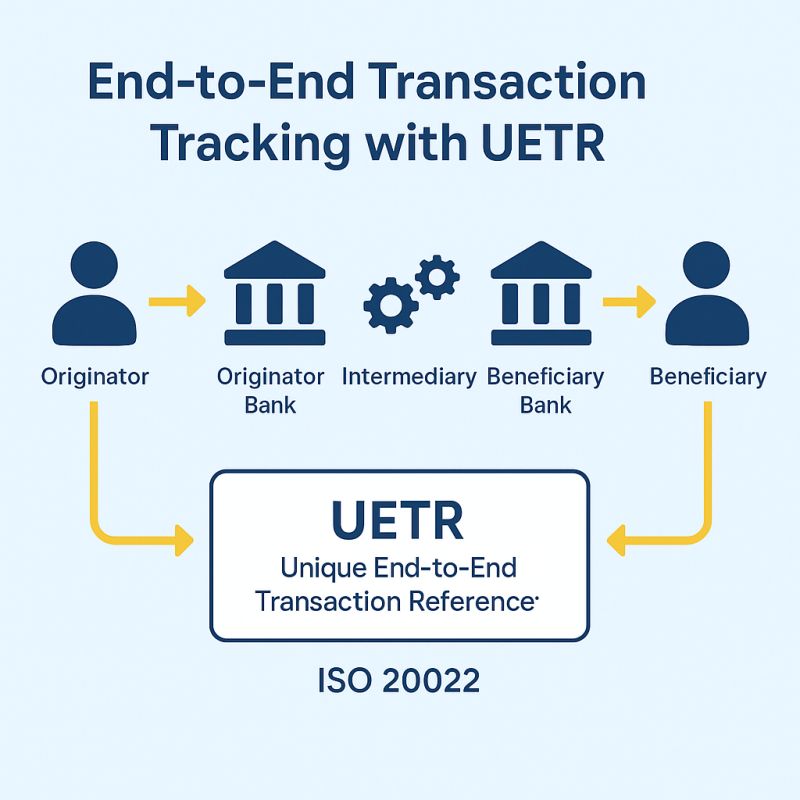
Every genuine SWIFT payment carries a Unique End-to-end Transaction Reference — a 36-character UETR created the moment the payment is sent and reported by every institution that touches it. That makes the UETR the one field on a payment copy that cannot be quietly edited in a PDF, and the fastest way to verify a payment: either a transaction exists under that reference, or it does not.
Verify a payment in three steps
- 01
Find the UETR on the document
Take the 36-character reference straight off the SWIFT copy, MT103 or payment confirmation you were given. It is usually labelled UETR, Unique End-to-end Transaction Reference, or field 121.
- 02
Paste it into the tracker
Enter the reference on the UETR Tracker home page. One submission sweeps the settlement network, the correspondent banks and the independent registries.
- 03
Read the verdict
A verified result shows the live status, amounts, currency and event history. No record at all means the document does not describe a payment that was sent — whatever it looks like on paper.
What one verification sweeps
There is no single public window into the world's payments, so verification means checking everywhere a reference can legitimately surface. One paste on this site runs the full sweep:
Settlement network
The messaging and settlement layer that carries every genuine SWIFT instruction. A real payment appears here within minutes of being sent, under its UETR.
Correspondent bank layer
The banks along the payment route that receive, forward and credit the funds. Each of them reports against the same reference, so a real payment leaves a trail at every hop.
Independent reference registries
Open registries and trackers that log end-to-end references as they move. A reference that exists nowhere, on any of these, does not belong to a sent payment.
Frequently asked questions
What does UETR verification actually prove?
It proves whether a transaction carrying that reference exists on the payment networks. A genuine SWIFT payment is visible under its UETR from the moment it is sent. If the reference returns no record anywhere, the payment it claims to describe was not sent.
What do I need to verify a payment?
Only the 36-character UETR, printed on the SWIFT copy, MT103 or payment confirmation. It looks like 97ed4827-7b6f-4491-a06f-b548d5a7512d. No account, no bank login, no fee.
How long does UETR verification take?
Under a minute. One submission is swept across the settlement network, the correspondent banks on the route and the independent registries, and you get a single verdict with the status, amounts and movement history when a record exists.
A payment was sent days ago but the UETR returns nothing. Why?
Genuinely sent payments are not purged and age alone never explains a missing record. The usual causes are a mistyped or altered reference, a payment that was instructed but never released, or a fabricated confirmation. Check the reference character by character first.
Can a fake payment have a real-looking UETR?
Yes — a forged document can carry a correctly formatted 36-character reference. Format proves nothing. Only the existence of a matching transaction, with matching amounts and parties, proves the payment.
Suspect the document itself? Read how to tell a real payment from a fake confirmation, or learn why this tracker exists.